
You’re Not Getting Free Anesthesia Anymore
Why the subsidy wave hit ASCs — and how both sides can win in the new reality

Last week I had a conversation with a CRNA entrepreneur who is building out an ASC platform on the West Coast. She is strategic, decisive, and fearless in a way that makes you both admire and envy her. You can tell she is going to win, not because she is lucky, but because she is building with clarity and conviction in a part of healthcare that is being completely rewritten in real time.
As we talked through the challenges of staffing, payor behavior, and growth strategy, the same realization hit us both: the ASC anesthesia market has quietly and completely transformed.
Five years ago, anesthesia services in ASCs were almost entirely unsubsidized. Maybe 15% of centers offered some kind of financial support to their anesthesia group. Today, it is flipped. Roughly 85–90% of ASCs now provide direct subsidy to maintain anesthesia coverage.
That is not an incremental shift. That is a tectonic plate moving.
And when something like that happens in a space as lean and profit-obsessed as outpatient surgery, it changes everything. It changes how groups contract, how owners plan, and how investors think about margin.
In plain terms, the old model is dead.
The drivers are not mysterious. They are the same twin forces reshaping the rest of the anesthesia ecosystem:
A persistent supply-demand imbalance for anesthesia clinicians that continues to drive compensation higher.
A steady erosion in revenue caused by commercial and federal payer tactics that chip away at what anesthesia collects per unit of time.
Put those together and you get an unprofitable equation: high labor costs, lower yield, and zero margin left for the group.
For a long time, the anesthesia side just absorbed it, cutting costs, running leaner, and hoping the market would normalize. But it did not. And it will not.
The result is what we are living in right now: a complete inversion of the ASC anesthesia business model. What was once a fee-for-service exchange has become a partnership underwritten by subsidy.
Cue the five stages of grief.
We have seen them all.
Denial: “No way. We have never paid a subsidy. We are not starting now.”
Anger: “This is ridiculous. Anesthesia should be grateful for our volume.”
Bargaining: “What if we pay per case or just bridge the gap for six months?”
Depression: “Margins are collapsing and anesthesia keeps walking.”
Acceptance: “Subsidy is part of the model. Let’s find the best partner and move forward.”
Across the country, ASCs are slowly migrating from denial toward acceptance. The smart ones are doing it faster.
In short, while we are seeing increased churn in hospital-based anesthesia contracts, the ASC side is experiencing it at a far higher rate because the ASC market behaves like a market. Quick decisions, rapid transitions, and relentless focus on margin. Hospitals are slower, more relational, and system-bound. That is a topic worth unpacking in a future article.
Closing Thought
The era of unsubsidized ASC anesthesia did not end quietly. It ended with a bang.
But in its place, a smarter, more transparent model is emerging.
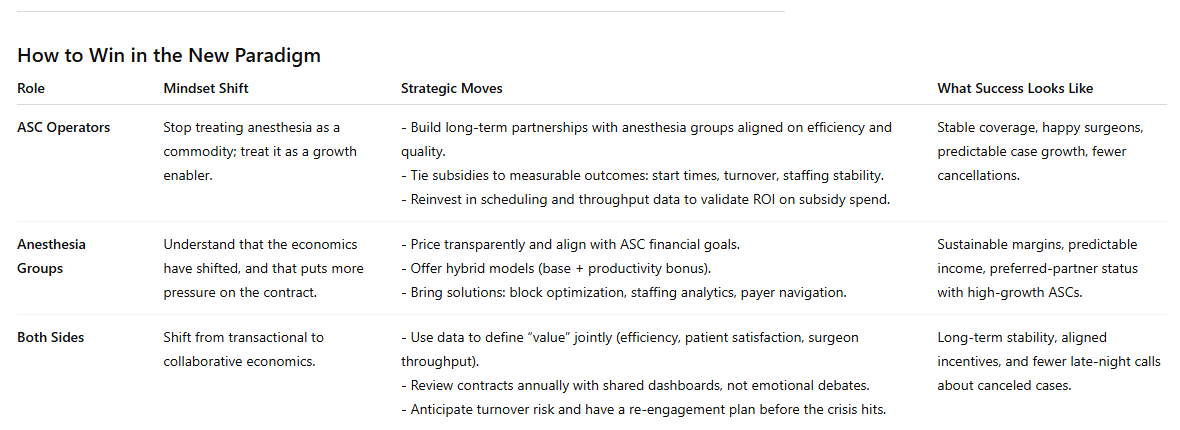
The winners will not be the ones who resist the change. They will be the ones who design the next equilibrium around it.
Well written and accurate. Food for thought for the practitioner group and ASC leadership. Thank you.